
Most people treat a recall notice as a minor inconvenience, a quick trip to the dealer and done. But understanding why Hyundai engine recall history matters goes much deeper than that. Recall records affect whether your car is safe to drive today, what it will fetch when you sell it, and whether you have legal rights to compensation you may not even know exist. For Hyundai owners and buyers, this history is one of the most revealing documents you can examine before making any decision about a vehicle.
Table of Contents
- Key takeaways
- Why Hyundai engine recall history matters: the technical roots
- The real safety stakes for Hyundai owners
- Legal and financial consequences you may not expect
- How recall history shapes resale value and long-term reliability
- Practical steps every Hyundai owner and buyer should take
- My take on what recall history actually reveals
- Engine Zone can help when recalls lead to engine replacement
- FAQ
Key takeaways
| Point | Details |
|---|---|
| Recalls signal deeper issues | Engine defects often reflect underlying manufacturing problems that persist even after official repairs. |
| Safety consequences are real | Documented incidents include fatalities and injuries directly linked to unresolved recall defects. |
| Compensation is available | Class action settlements offer warranty extensions, reimbursements, and trade-in loss compensation for eligible owners. |
| Resale value is affected | A vehicle’s recall history directly influences buyer confidence and market depreciation. |
| Documentation is your protection | Keeping receipts and service records is the difference between claiming what you are owed and missing out entirely. |
Why Hyundai engine recall history matters: the technical roots
To understand the Hyundai recall significance, you first need to know what is actually going wrong inside these engines. The most widespread issues trace back to manufacturing defects in the Theta II and Nu engine families, which powered millions of Sonata, Tucson, and Santa Fe models across multiple model years.
The core problem in many cases was improper heat treatment of piston rings during the manufacturing process. When piston rings are not hardened correctly, they wear faster than designed. Metal debris circulates through the oil system, scoring cylinder walls and starving bearings of lubrication. The engine does not fail suddenly in most cases. It degrades gradually, and by the time the damage is visible, it is often catastrophic.
Subtle engine symptoms like knocking sounds and increased oil consumption often precede total failure, which means owners frequently miss the warning window entirely. Other defects have shown up in connecting rod bearings, oil system passages, and combustion chambers across different model years, making the historical Hyundai engine issues broader than any single production batch.
Here are the most common early warning signs owners should watch for:
- Unusual knocking or ticking sounds from the engine bay, particularly on cold starts
- Oil consumption above 1 litre per 1,000 kilometres without visible leaks
- The engine oil pressure warning light activating intermittently
- A burning smell from the engine compartment, often indicating oil contacting hot surfaces
- Unexpected engine stalling or hesitation during acceleration
Pro Tip: If your Hyundai is consuming oil faster than expected or producing any knocking sound, book an inspection before the next service interval, not after. Waiting for a scheduled service date can mean the difference between a repair and a full engine replacement.
The scale of these recalls has been significant. Multiple campaigns have covered hundreds of thousands of vehicles across Australia and globally. Engine defects from improper heat treatment create subtle degradation that continues even after some repair procedures, meaning the impact of Hyundai engine recalls extends well beyond the initial fix.
The real safety stakes for Hyundai owners
The importance of recall history becomes impossible to ignore once you look at what has actually happened to drivers who did not act on notices promptly. Engine fires have been documented in recalled vehicles where owners delayed repairs. Oil starvation failures have caused loss of power on highways. These are not theoretical risks.
The 2026 Hyundai Palisade recall made the consequences impossible to dismiss. A power-folding seat defect led to at least one child fatality and multiple injuries across 61,093 vehicles, triggering both a major recall and a stop sale order. This example illustrates that Hyundai vehicle safety records encompass far more than engine components. Safety failures can emerge across multiple systems, and the consequences can be fatal.
Recalls are not bureaucratic formalities. They are formal acknowledgements that a known defect exists in your vehicle and that driving it without a remedy carries documented risk. Treating a recall notice as optional reading is not a calculated risk. It is an uninformed one.
Nearly 294,128 vehicles were recalled over seat belt anchor defects that could cause detachment during a crash. That is a defect in the one system designed to keep you in the vehicle during the moment that matters most.
Hyundai provides free inspections and repairs for recalled vehicles regardless of warranty status, and reimbursement programmes exist for owners who paid out of pocket before the recall was announced. The barrier is awareness and follow-through, not cost.
Pro Tip: Register your vehicle’s VIN at the Australian Government’s Product Safety Australia website and with Hyundai Australia directly. You will receive notifications when new recalls affect your model, rather than finding out months later from a secondhand source.
Legal and financial consequences you may not expect
Why engine recalls matter financially is a story most owners only discover after the fact. The direct cost of repairs handled under recall is zero to the owner. But the indirect costs are where things get complicated.

Class action settlements in multiple jurisdictions have produced meaningful benefits for affected Hyundai owners, including extended warranties covering engines beyond the original terms, cash reimbursements for pre-recall repair expenses, and compensation for trade-in losses suffered when owners sold affected vehicles at a depreciated value. These are real financial recoveries, but only for owners who document their situation correctly.
The table below outlines common compensation types available through recall-related legal outcomes:
| Compensation type | Who is eligible | What to provide |
|---|---|---|
| Repair reimbursement | Owners who paid for repairs later covered by recall | Dated receipts and service records |
| Warranty extension | All affected vehicle owners registered with Hyundai | VIN registration and ownership proof |
| Trade-in loss compensation | Owners who sold at a loss during recall period | Sale documentation and recall notice dates |
| Out-of-pocket expenses | Owners with costs linked to recall defect | Receipts for hire cars, towing, and related costs |
The financial and operational strain from large-scale recalls extends well beyond direct repair costs for manufacturers, encompassing legal claims, regulatory penalties, and brand damage. For owners, the parallel reality is that the financial impact of a recall on your personal situation depends almost entirely on whether you take the steps to claim what you are entitled to.
A vehicle with unresolved recall history also creates insurance complications. Some policies treat a known defect as a contributing factor in accident liability assessments. Checking your recall status is not just about safety. It is about protecting your financial position in multiple directions.
How recall history shapes resale value and long-term reliability
The Hyundai engine reliability concerns connected to recall history do not simply disappear once a repair is completed. Buyers researching a used Hyundai will check the VIN against recall databases. A vehicle with a documented, unresolved recall is harder to sell and attracts lower offers. Even a resolved recall raises questions for informed buyers about what other issues might exist.
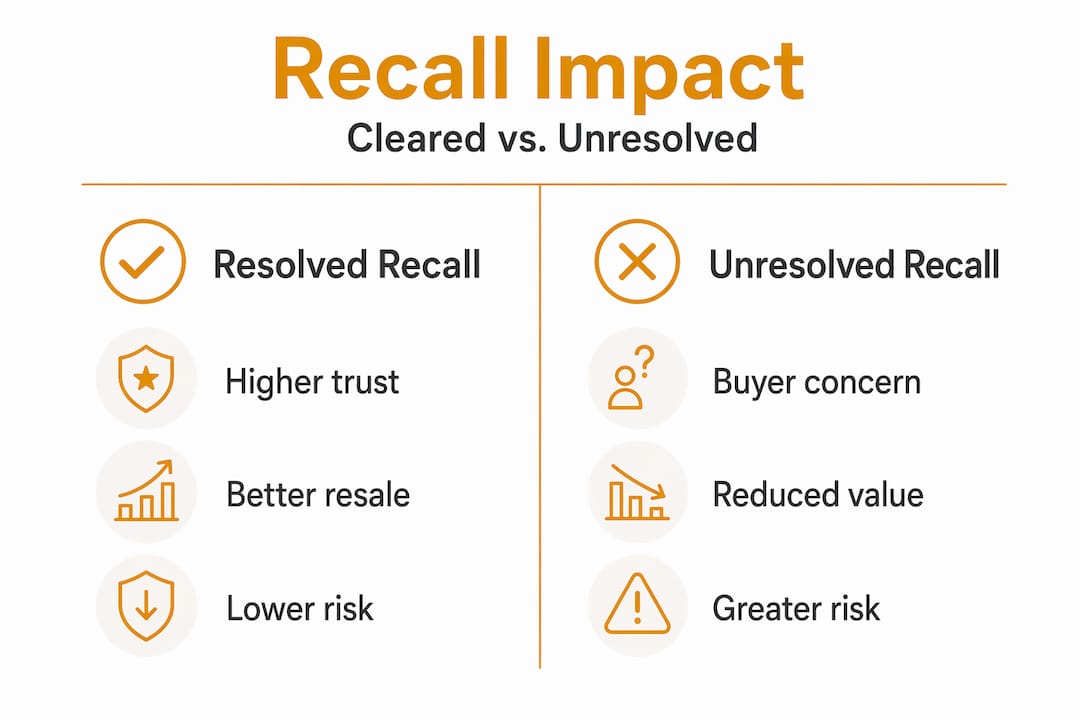
The comparison below reflects how recall history typically affects market positioning:
| Factor | Vehicle with clear recall history | Vehicle with unresolved recall |
|---|---|---|
| Buyer confidence | Higher, especially with documented repairs | Lower, creates negotiating leverage against seller |
| Private sale price | Closer to market average | Typically 5 to 15 per cent below equivalent models |
| Trade-in acceptance | Standard assessment process | May be refused or heavily discounted |
| Finance approval | Standard risk profile | Lender may require defect resolution before approval |
Engine defects that cause subtle degradation continue affecting long-term durability even after recall repairs in some cases, because the damage incurred before the repair cannot always be reversed. This is why maintenance records matter as much as the repair receipt itself. A vehicle that had an engine replaced under recall but has complete service documentation is a very different proposition from one where the owner has no paperwork.
Pro Tip: When buying a used Hyundai, request the full service history and check the VIN independently against Hyundai Australia’s recall portal and the national database. A seller who cannot provide both is asking you to take on risk they could not quantify themselves.
Practical steps every Hyundai owner and buyer should take
Understanding the importance of recall history is one thing. Doing something about it is another. Here is a clear process to follow regardless of whether you currently own a Hyundai or are considering buying one.
- Check the VIN immediately. Use the Australian Government’s Product Safety Australia recall checker and Hyundai Australia’s official portal. Enter the 17-character VIN found on the driver’s door frame or dashboard.
- Register for recall notifications. Create an account with Hyundai Australia using your VIN. This places you on the direct notification list for any future recalls affecting your model.
- Book the recall repair without delay. Hyundai’s recall repairs are free of charge and do not require proof of purchase or warranty status.
- Gather your documentation now. Collect all service receipts, repair invoices, and correspondence with dealers. Retaining receipts is critical to claiming any out-of-pocket reimbursements connected to a recall defect.
- Investigate class action eligibility. Search for active or settled class actions related to your vehicle’s specific recall. Many settlements have claim deadlines that owners miss simply from not being aware.
- Document any symptoms in writing. If your vehicle shows any warning signs before a recall is formally announced, note the date, mileage, and symptoms. This log can support a reimbursement or warranty claim later.
- Negotiate with knowledge when buying. If a used Hyundai you are considering has a recall history, use that as a basis for price negotiation and insist on documented proof that the remedy was completed.
My take on what recall history actually reveals
I’ve spent years working in and around the automotive parts industry in Australia, and what I’ve consistently observed is this: owners treat recall history as a footnote when it is actually a headline.
The manufacturers’ tendency to describe recalls in neutral technical language obscures what is really being said. When Hyundai issues a recall affecting hundreds of thousands of vehicles, it is acknowledging that a known defect exists in cars currently on Australian roads. That matters far more than the press release language suggests.
What I find genuinely troubling is how many owners I’ve spoken to who received recall notices, set them aside, and only acted after their engine failed or after they struggled to sell their vehicle. Recalled vehicles can be difficult to trade during active safety investigations, leaving owners financially stranded in the gap between defect acknowledgement and resolution. That is a gap no one tells you about when you buy the car.
My view is that recall history should carry the same weight as a logbook service history in any purchase decision. An informed buyer demands both. And an informed owner treats every recall notice as a priority, not a suggestion. The Hyundai vehicle safety records are publicly accessible. There is no reason to make ownership decisions without consulting them.
— Jason
Engine Zone can help when recalls lead to engine replacement
When a Hyundai engine recall results in damage that goes beyond what a dealer repair can fix, or when you have inherited a vehicle with a compromised engine, a quality replacement is often the most reliable path forward.
Engine Zone stocks a curated range of new, tested, and guaranteed replacement engines for Hyundai and Kia vehicles, with delivery across Australia and up to 25% off standard pricing. Every engine comes with fitment guarantees and expert support to match the right unit to your specific model and build year. Whether you are a private owner, mechanic, or fleet operator, the team at Engine Zone can help you identify the correct engine and get your vehicle back on the road with confidence.
Browse the 1.4L G4LC replacement engine for Kia Rio models, or explore the 2.0L G4NC engine for Cerato applications. For anything else, the Engine Zone team is available to assist with model fitment and sourcing the right solution for your situation.
FAQ
What are the most common Hyundai engine recall defects?
The most widespread historical Hyundai engine defects involve improper heat treatment of piston rings in Theta II and Nu engine families, leading to premature wear, oil starvation, and in some cases engine fire risk.
Does a resolved recall affect resale value?
Yes. Even a resolved recall can reduce buyer confidence and negotiating position, particularly if the owner cannot provide documented proof that the recall repair was completed correctly.
How do I claim reimbursement for pre-recall repair costs?
Contact Hyundai Australia directly with dated receipts for any repairs that fall within the scope of the recall. Reimbursement programmes are available regardless of warranty status, but receipts are required to process any claim.
Can I trade in or sell my Hyundai during an active recall?
It is possible but complicated. Regulators may defer buybacks until a permanent fix is available, and some dealers will not accept trade-ins with unresolved safety defects.
How do I check if my Hyundai has an active recall in Australia?
Enter your vehicle’s 17-character VIN at the Product Safety Australia recall portal or through the Hyundai Australia website. Both databases are updated when new recalls are announced.