
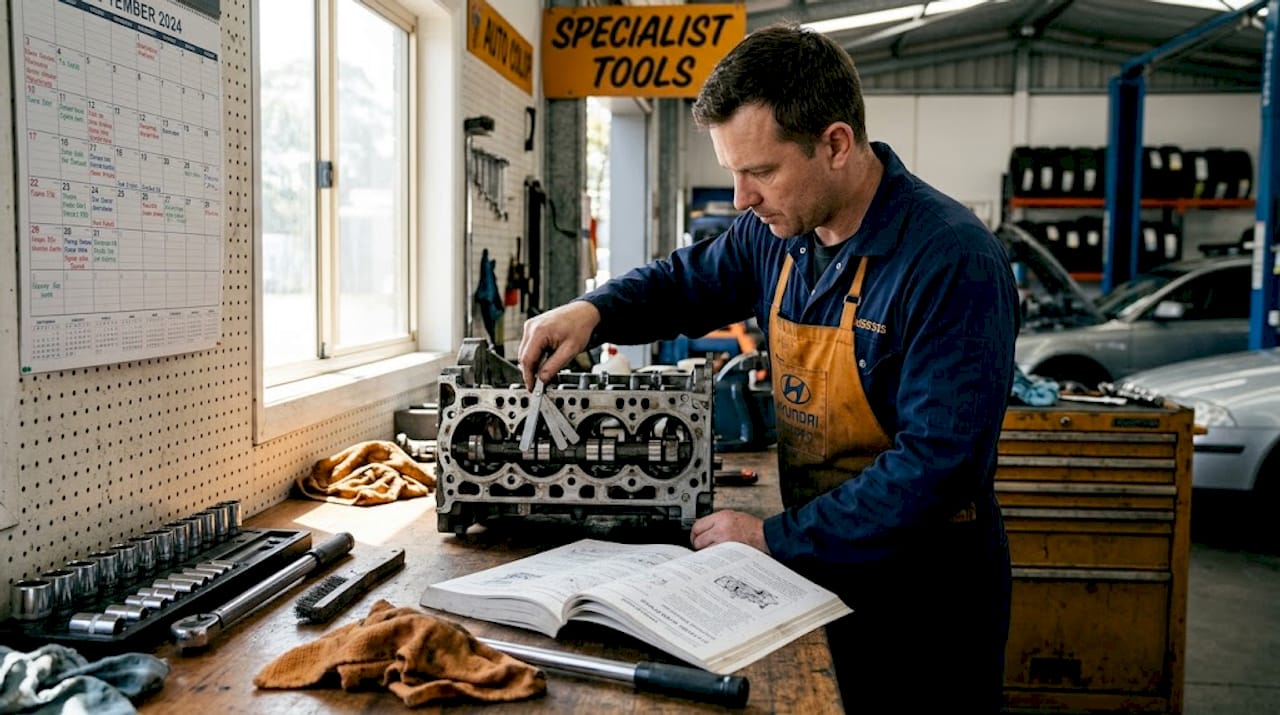
Many vehicle owners and even some mechanics assume engine reconditioning is simply a matter of swapping worn parts for new ones. It is not. Understanding what is engine reconditioning standard means recognising it as a precision restoration process governed by strict manufacturer tolerances, specialist machining, and systematic quality checks. For Hyundai and Kia engines specifically, these standards determine whether a reconditioned engine delivers another 200,000 kilometres or fails within the first 20,000. This guide breaks down exactly what those standards involve, why they matter, and how to ensure any reconditioning work on your vehicle meets them.
Table of Contents
- Defining engine reconditioning and its standards
- Distinguishing reconditioning from rebuild and remanufacture
- Key standards and industry guidelines for Hyundai and Kia engines in Australia
- Technical process and critical quality checks during engine reconditioning
- Practical advice for automotive professionals and vehicle owners
- Rethinking engine reconditioning: common myths and overlooked standards
- Explore quality engine solutions for your Hyundai and Kia vehicle
- Frequently asked questions
Key Takeaways
| Point | Details |
|---|---|
| Precise restoration | Engine reconditioning restores core Hyundai and Kia engine parts to factory tolerances using precision machining. |
| Process clarity | Reconditioning differs from rebuild and remanufacture in scope, cost, and outcomes for engine longevity. |
| Manufacturer specs | Strict adherence to factory torque, clearances, and replacing critical fasteners is vital for reliability. |
| Technical rigor | Use of torque plates and thorough measurement ensures bores remain round and engines perform well. |
| Informed decisions | Request detailed work scopes and choose reconditioning to maximise engine life and value. |
Defining engine reconditioning and its standards
Engine reconditioning is a specialised restoration process involving complete disassembly, cleaning, machining, and reassembly to strict manufacturer tolerances. That definition carries real weight. It is not a top-end service. It is not a gasket swap. It is a ground-up restoration of the core engine assembly, guided by a precise set of guidelines that dictate every measurement, torque value, and surface finish.
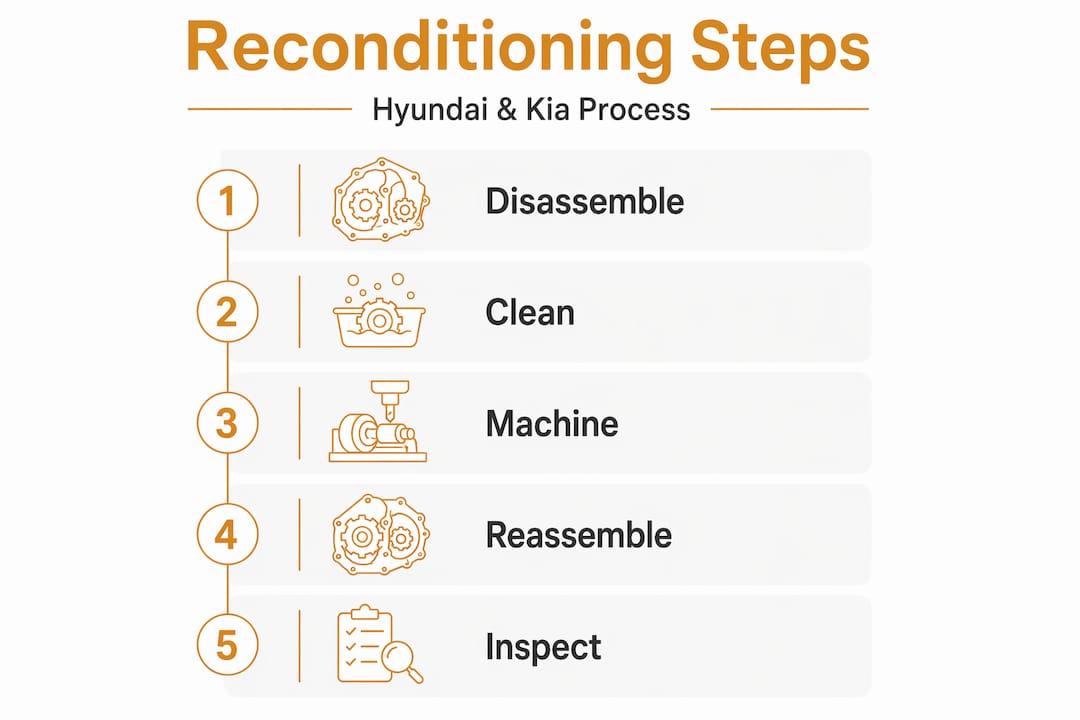
The engine reconditioning process follows a structured sequence of stages. Skip or shortcut any one of them and the whole job is compromised, regardless of how good the parts are.
The core stages of engine reconditioning are:
- Diagnosis and inspection — Identifying the root cause of failure or wear before any disassembly begins.
- Full disassembly — Stripping the engine to its individual components, including crankshaft, pistons, connecting rods, camshaft, and all ancillaries.
- Chemical cleaning — Removing carbon deposits, sludge, and scale from all surfaces using hot-tank or ultrasonic cleaning equipment.
- Precision measurement — Measuring bore diameter, crankshaft journals, bearing clearances, and valve guide wear against factory specifications.
- Machining — Cylinder boring and honing, crankshaft grinding, valve seat cutting, and surface milling to restore geometry.
- Reassembly with new wear components — Installing new pistons, rings, bearings, gaskets, seals, and timing parts.
- Final testing — Verifying compression, oil pressure, and operational performance before the engine leaves the workshop.
Engine reconditioning definition goes beyond parts. It includes the geometry of the engine. The block must be flat. The bores must be round. The crankshaft journals must be within tolerance. These are the standards that separate a reconditioned engine from one that has simply had a tidy-up.
What reconditioning restores and why it matters:
- Original bore diameter and surface finish for ring seal
- Crankshaft journal dimensions for correct bearing clearances
- Valve seat geometry for combustion efficiency
- Head surface flatness for gasket integrity
- Component balance for smooth operation
For Hyundai and Kia vehicles, maintaining the original engine block is particularly important. These engines are well-engineered and the blocks themselves are durable. Restoring to factory spec rather than replacing the block outright preserves the vehicle’s value and keeps repair costs realistic. Explore the engine reconditioning standards for Kia Rio to see what factory-specification engines look like in practice.
Distinguishing reconditioning from rebuild and remanufacture
These three terms are used interchangeably in workshops and online, but they describe very different scopes of work. Mixing them up leads to mismatched expectations, cost blowouts, and engines that do not last. Reconditioning restores original core components, remanufacture is factory-standardised with all parts replaced, and rebuild fixes specific faults. Understanding the distinction helps you match the process to the engine condition and budget.
| Process | Scope of work | Cost | Expected lifespan extension | Best suited for |
|---|---|---|---|---|
| Rebuild | Fixes identified faults, replaces only failed parts | Lowest | Moderate | Localised damage, tight budget |
| Reconditioning | Restores core components with machining, replaces all wear parts | Mid-range | High | General wear, good block condition |
| Remanufacture | Full parts replacement to factory spec, new or re-engineered block | Highest | Near new engine | Severe damage, fleet applications |
Key differences to keep in mind:
- A rebuild may not include any machining at all. The focus is on what broke, not what wore.
- Reconditioning always includes precision measurement and machining. That is what makes it a standard-driven process.
- Remanufacture is essentially building a new engine using the original block as a platform, with every wearable part replaced regardless of current condition.
- For most Hyundai and Kia owners dealing with high-mileage wear rather than catastrophic damage, reconditioning represents the best balance of cost and outcome.
Choosing the wrong process is a common and expensive mistake. An engine that needs reconditioning but only receives a rebuild will likely fail again within 50,000 kilometres. An engine that could be reconditioned but is remanufactured unnecessarily costs the vehicle owner thousands more than required.
Key standards and industry guidelines for Hyundai and Kia engines in Australia
When it comes to Hyundai and Kia engines specifically, engine reconditioning guidelines are not generic. These vehicles use aluminium block construction across most modern models, which introduces specific requirements that differ from older cast-iron engines. Rebuilding Hyundai and Kia engines requires strict adherence to factory service manual specs for torque and clearances critical for reliability.
Critical standards for Hyundai and Kia engine reconditioning:
- Factory torque sequences — Aluminium threads strip easily. The correct torque values and tightening sequences from the service manual are non-negotiable.
- Bearing clearances — These engines are designed with tight oil clearances. Deviating even slightly affects oil pressure and bearing life.
- Cylinder head bolt replacement — Most modern Hyundai and Kia engines use torque-to-yield head bolts, which must be replaced every time the head is removed. Reusing them risks head gasket failure.
- Connecting rod bolts — Reuse of factory rod bolts in Hyundai and Kia aluminium engines is a critical failure point and they must always be replaced during reconditioning.
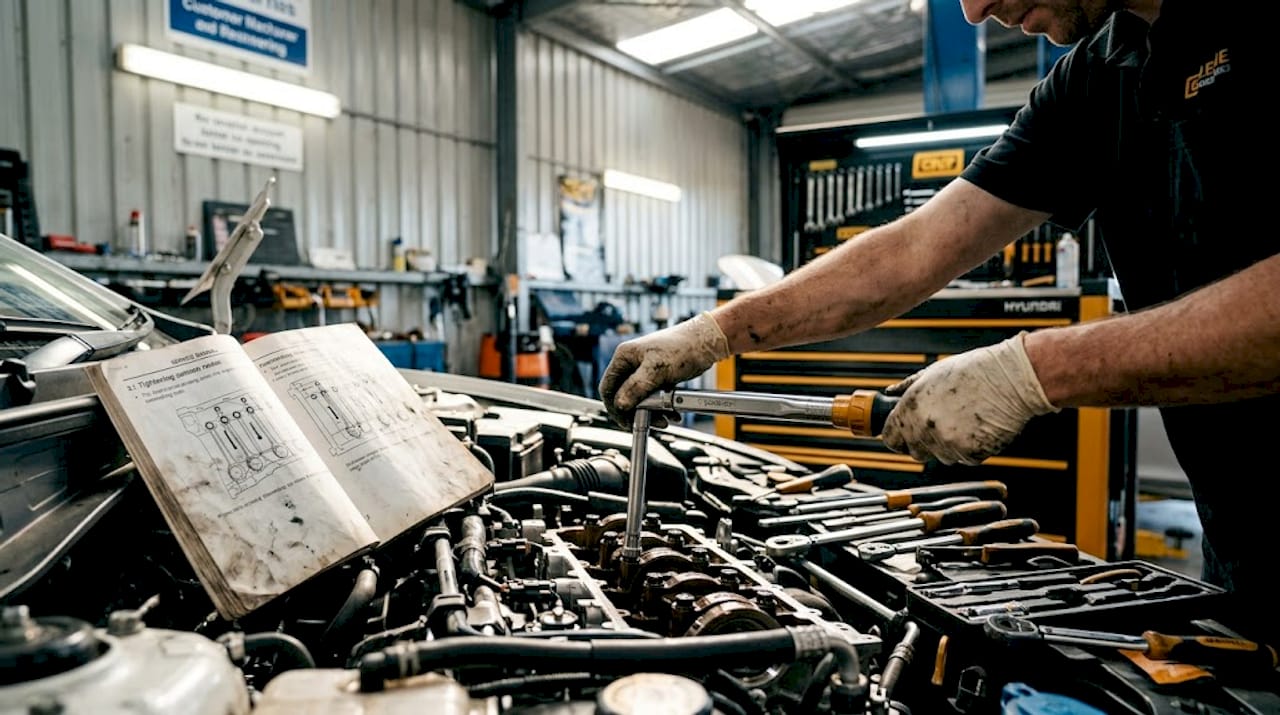
- Torque plate honing — Boring and honing the cylinders with a torque plate bolted to the block simulates the stress of the cylinder head, ensuring bores are truly round under operating conditions.
- Surface finish specifications — Cylinder wall surface finish is measured in Ra (roughness average) values. Too smooth and rings will not seat. Too rough and wear accelerates.
The rod bolt issue deserves special attention. These are stretch bolts. Once torqued, the bolt has plastically deformed. Reusing it under full engine load risks fatigue failure, which means a connecting rod departing the engine at high speed. It is not a cost-saving measure. It is a catastrophic risk.
Pro Tip: Always request the factory service manual torque specifications from your workshop in writing before authorising reconditioning work. If they cannot provide them or do not reference them, find another workshop.
Technical process and critical quality checks during engine reconditioning
Walking through the technical process of how to recondition an engine reveals why this work demands skilled tradespeople and proper equipment, not just mechanical enthusiasm.
“The biggest detail most people miss is that cylinder boring without a torque plate produces a round bore in the machine shop and an oval bore in the car. The torque plate replicates the distortion the cylinder head causes, so the bore is round where it matters — under load.”
The full reconditioning process step by step:
- Disassembly and initial inspection — All components are catalogued and inspected for damage beyond what machining can address.
- Chemical cleaning — Hot-tank or ultrasonic cleaning removes all carbon, varnish, and sludge. Galleries and oil passages are flushed and blown clear.
- Precision measurement — Bore diameter, taper, and out-of-round are measured. Crankshaft journals are miked. Valve guides and seats are checked. Everything is compared to factory specifications.
- Machining — Cylinder boring and honing with a torque plate simulates cylinder head stress, keeping bores perfectly round under load. Crankshaft journals are ground and polished. Valve seats are cut to the correct angles and widths.
- Parts selection and fitment — New pistons are matched to the bored diameter. Bearing sets are selected to match reground journal dimensions. All seals, gaskets, rings, and timing components are replaced.
- Assembly to specification — Every fastener is torqued in the correct sequence using a calibrated torque wrench. Rod bolts, main bearing caps, and head bolts all receive fresh hardware.
- Final testing — Compression testing, oil pressure measurement, and a controlled run-in verify the engine meets performance standards before delivery.
Pro Tip: Ask your workshop whether they degree the camshaft during reassembly. Verifying camshaft timing against factory specifications is a step that distinguishes thorough reconditioning from a hurried job. Even a few degrees of error affects power delivery and fuel economy.
Practical advice for automotive professionals and vehicle owners
Engine rebuild standards only protect you if you know how to apply them. Whether you are a mechanic managing a reconditioning job or an owner authorising one, these guidelines save time, money, and frustration.
What to confirm before any reconditioning work starts:
- Scope of work in writing — Is this a refresh (new seals and gaskets) or a full recondition with machining? The cost and outcome are completely different.
- Machining equipment — Does the workshop have an engine lathe, boring bar, and surface grinder on site, or do they outsource machining? Outsourced machining adds time and communication gaps.
- Torque plate availability — Not every engine workshop owns torque plates for every engine family. If they do not, bore geometry will suffer.
- Parts brands — OEM or OEM-equivalent parts should be used for rings, bearings, and gaskets. Cheap aftermarket parts undermine quality machining work.
- Choosing parts for Kia engine reconditioning is as important as the machining itself. Factory-specification components ensure the reconditioned assembly performs as designed.
Realistic expectations for full reconditioning:
- Timeline — Allow two to four weeks minimum for a full recondition, including machining turnaround.
- Cost — For Hyundai and Kia four-cylinder engines, expect costs between $2,500 and $5,000 depending on engine condition and parts required.
- Longevity — A properly reconditioned engine should deliver engine life comparable to the original, often exceeding 150,000 kilometres with correct servicing.
Pro Tip: If a workshop quotes less than $1,500 for a full engine recondition including machining, ask very specific questions about what is actually included. In most cases, that price reflects a refresh, not a true recondition. What is engine refurbishment at a budget price often means new gaskets and not much else.
Rethinking engine reconditioning: common myths and overlooked standards
Here is the uncomfortable truth most guides will not say directly: a significant number of engines that leave workshops labelled as “reconditioned” have not been reconditioned at all. They have been freshened up. New gaskets, maybe a set of rings, certainly a clean. But no machining, no precision measurement, no torque plate boring.
The biggest misconception is that reconditioning is just replacing parts. It actually demands meticulous machining restoring engine geometry to factory-new specifications. When workshops skip this, the new parts they install are working inside worn, out-of-round, out-of-spec geometry. Rings that cannot seal properly. Bearings sitting in journals with incorrect clearances. The result is an engine that burns oil and loses compression within 30,000 kilometres despite having “new” components fitted.
The second myth is that engine reconditioning is only for high-kilometre engines facing failure. Proactive reconditioning at 200,000 to 250,000 kilometres, before catastrophic wear occurs, almost always delivers better outcomes and lower costs than waiting for the engine to fail. When you recondition a tired but intact engine, you are working with clean, undamaged geometry. When you recondition after a failure, you are often dealing with scored bores, damaged crankshaft journals, and stress-fractured components that require far more remediation.
For Hyundai and Kia owners specifically, understanding what genuine engine reconditioning standards require is your best protection against paying for work that falls short. Ask for the measurement records. Ask to see the machining invoice. Ask for the part numbers of the components installed. A workshop doing the job properly will have no issue providing all of this. One doing a quick refresh will not.
Explore quality engine solutions for your Hyundai and Kia vehicle
Now that you understand what true engine reconditioning standards involve, you may find that a brand new factory-specification engine is a more practical solution for your situation.
Engine Zone supplies brand new 1.4L petrol long engines for Kia Rio and 2.0L petrol long engines for Kia Cerato, built to the same factory tolerances described throughout this guide. Every engine comes tested, guaranteed for fitment, and shipped free across Australia. For mechanics and fleet operators who need a known-good engine without the three to four week reconditioning turnaround, this is a direct, cost-effective path to the same outcome. Browse the full range at Engine Zone and compare pricing against reconditioning quotes with confidence.
Frequently asked questions
What does engine reconditioning standard mean for Hyundai and Kia engines?
It means restoring core engine components to strict factory tolerances through precise machining, ensuring reliable and long-lasting performance. Engine reconditioning is a specialised restoration process returning the engine to precise manufacturer tolerances, not simply replacing worn parts.
Is engine reconditioning the same as a rebuild or remanufacture?
No. Reconditioning focuses on restoring original parts through machining, rebuilding targets specific faults only, and remanufacture replaces all wearable parts to factory standards. Reconditioning restores original core components where rebuild fixes specific faults and remanufacture is fully factory-standardised.
Why is replacing rod bolts important in Hyundai and Kia engine reconditioning?
Factory rod bolts in aluminium block engines are stretch bolts that deform under load and cannot be safely reused. Reuse of factory rod bolts is a critical failure point and professional reconditioning mandates replacing them to prevent catastrophic engine damage.
How can I ensure my engine reconditioning meets industry standards?
Request a written scope of work confirming machining is included, ask for the factory service manual torque specifications that will be followed, and verify that torque plate honing is part of the cylinder work. Vehicle owners should request a detailed scope and understand the difference between a refresh and a full recondition before authorising any work.