
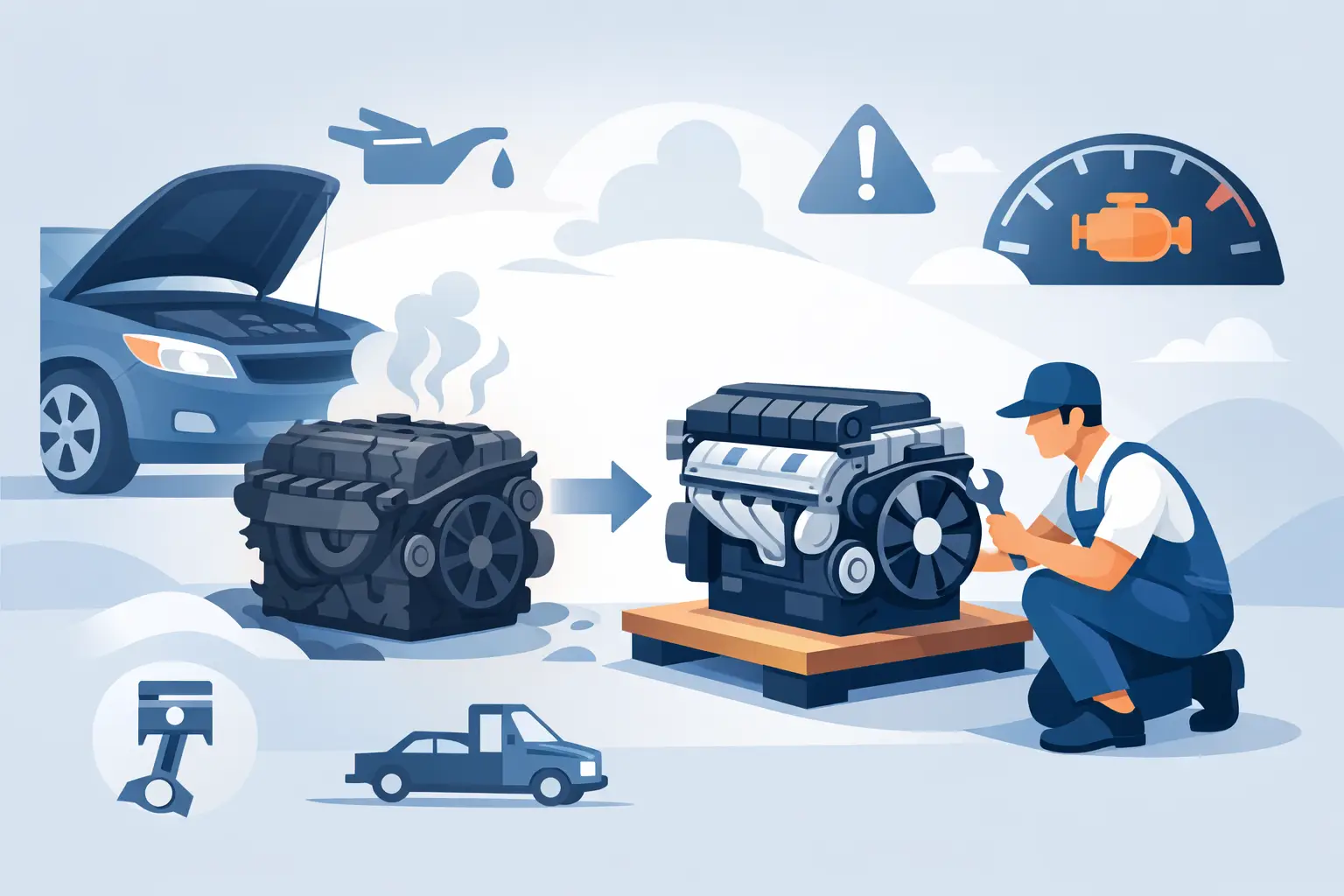
A Hyundai or Kia that suddenly starts chewing through oil, blowing smoke, or knocking under load is not just having a bad week. In many cases, these are the top signs engine replacement needed rather than another round of small repairs. If the vehicle is off the road, losing power, or costing you more every month, the real question is no longer what failed. It is whether the engine is still worth repairing.
For owners, workshops, and trade buyers, that decision usually comes down to cost, downtime, and certainty. A minor issue can be fixed. A worn-out or damaged engine often turns into repeat labour, more parts, and no real confidence that the problem is solved. That is why recognising the warning signs early matters.
Top signs engine replacement needed before total failure
Some engines fade slowly. Others let go with very little warning. Either way, there are a few symptoms that usually point to internal wear or major damage rather than a simple bolt-on repair.
Persistent oil consumption
If the engine is using oil between services and there are no major external leaks, oil is often getting past worn piston rings, valve stem seals, or damaged cylinder walls. Topping it up once might not seem serious, but regular oil loss is a sign the internals are no longer sealing as they should.
This matters because oil burning rarely fixes itself. It usually gets worse over time, and if the oil level drops too far, the engine can suffer bearing damage, overheating, or total seizure. On an older vehicle, repeated oil-related repairs can quickly outweigh the value of a proper replacement engine.
Blue or white exhaust smoke
Blue smoke generally points to oil burning in the combustion chamber. White smoke can suggest coolant entering the engine, often through a failed head gasket or cracked head. In some cases, a head gasket repair is enough. In others, especially where the engine has overheated badly, the damage runs deeper.
The trade-off here is important. A workshop might repair the top end, but if the bottom end has also suffered, you are still left with a tired engine. When smoke is constant, heavy, and backed up by compression issues or coolant loss, replacement is often the cleaner fix.
Engine knocking or bottom-end noise
A knocking sound from the lower part of the engine is one of the clearest danger signs. Worn bearings, crankshaft damage, or lubrication failure can all cause a deep metallic knock that rises with revs. Once that noise starts, the engine is already in trouble.
Some owners try to keep driving with a knock to buy time. That usually makes things worse. A bearing issue can turn into complete failure without much notice, leaving you with more damage and fewer options. If the knock is confirmed internally, replacement is usually the most practical path.
Low compression across one or more cylinders
Low compression means the engine is struggling to seal and build pressure where it counts. That can come from worn rings, burnt valves, head gasket failure, or bore damage. The symptoms are familiar: hard starting, rough idle, poor fuel economy, reduced power, and misfires.
A single low cylinder might be repairable depending on the cause. Multiple low cylinders usually point to a worn engine overall. When compression numbers are poor across the board, a replacement engine often gives better value than chasing an overhaul.
When repair stops making financial sense
Not every damaged engine needs to be replaced straight away. But there is a point where continued repair becomes the expensive option.
Repeated overheating and coolant loss
One overheating event can be enough to warp a cylinder head, damage the head gasket, or stress the block. If the vehicle has overheated more than once and keeps losing coolant, you need to look beyond the immediate fix. Replacing a thermostat or radiator may solve the symptom for a while, but it will not reverse internal engine damage.
This is where many owners get caught. They pay for one cooling system repair, then another, then discover the engine itself is compromised. If the vehicle still has good value and the rest of it is sound, a replacement engine can be the more sensible long-term spend.
Metal in the oil or sump
Metal shavings in the oil or sump are a serious red flag. They suggest active internal wear, often from bearings, pistons, or valvetrain components. Once metal is circulating through the lubrication system, it can damage other engine parts quickly.
At that stage, patching one failed component may not be enough. You are dealing with contamination and wear that can affect the whole engine. For workshops especially, fitting a replacement engine can reduce comeback risk compared with repairing a badly contaminated unit.
Major loss of power under load
If the vehicle feels flat, struggles on hills, hesitates under acceleration, or cannot hold normal speed without strain, the problem may be deeper than spark, injectors, or sensors. A tired engine can still idle and run, but fail when asked to do real work.
Power loss on its own does not always mean replacement. It depends on the diagnosis. But when power loss is paired with smoke, noise, low compression, or heavy oil use, it is one of the top signs engine replacement needed rather than another round of fault-finding.
Signs the issue is internal, not just an accessory fault
It is easy to mistake engine problems for issues with turbo components, ignition parts, fuel delivery, or the cooling system. Those faults can cause rough running and poor performance too. The difference is that accessory faults are usually isolated. Internal engine faults tend to show up in combinations.
For example, if you have smoke, oil loss, poor compression, and a knock, that points to the engine itself. If you have a coolant leak, overheating, and milky oil, internal damage is high on the list. If you have a single fault code but the engine is otherwise healthy, replacement may be premature.
That is why proper testing matters. Compression testing, leak-down testing, oil inspection, and cooling system checks can save guesswork. The goal is not to spend money proving the engine is dead. The goal is to avoid spending money on repairs that will not hold.
When replacement is the smarter option than a rebuild
A rebuild sounds appealing because it feels targeted. You keep the original engine and replace only what is worn. In practice, rebuilds can blow out on labour, machining, and extra parts once the engine is opened up. They also take time, which matters if the vehicle is a daily driver or workshop job tying up a bay.
A replacement engine makes more sense when the original unit has widespread wear, serious bottom-end damage, or overheating-related issues that affect multiple components. It also suits buyers who want clearer fitment, faster turnaround, and less uncertainty.
For Hyundai and Kia owners, matching the right engine code matters just as much as diagnosing the fault. The wrong engine can create delays and compatibility headaches. The right replacement, supplied against the correct application, cuts out a lot of that risk.
What to check before you commit
Before replacing the engine, confirm the engine code, vehicle year, fuel type, and any model-specific variations. This is especially important across Hyundai and Kia ranges where similar models may use different engines depending on build date or trim.
You should also look at the vehicle as a whole. If the transmission, body, and running gear are still solid, replacement can extend the life of the car without the cost of changing vehicles. If the car has major issues beyond the engine, the numbers may not stack up.
For workshops and trade buyers, turnaround and fitment certainty are often just as important as purchase price. A cheaper engine that does not match properly is not cheaper once labour and downtime are added in. That is why specialist supply matters.
Engine Zone works with buyers who want that process to be straightforward – clear application matching, expert support, secure purchasing, and Australia-wide delivery without the usual runaround.
The real cost of waiting too long
The longer a failing engine is driven, the more likely it is to damage related components or leave the vehicle stranded. A worn engine can foul spark plugs, damage the catalytic converter, contaminate the cooling system, or fail without warning in traffic or on the highway.
Acting early gives you more control. You can compare options, confirm fitment, book installation, and avoid the stress of an emergency breakdown. If your Hyundai or Kia is showing multiple warning signs, the smart move is to treat it as a replacement decision now, not after the engine makes that decision for you.